Buying a lake home is an exciting process. However, getting caught up in the excitement often leads to costly mistakes. Glen Phillips, CEO of Lake Homes Realty, discusses 4 costly mistakes made by lake home buyers.
Lack of Due Diligence: Conflict between buyers and sellers often arises, even after the sale, due to a lack of information. Here are a few tips to avoid this conflict:
Home Inspection: Think of home inspections as an insurance expense. Homes, especially lake homes, have issues as they age. A home inspection is less expensive than finding issues after you purchase the home.
Survey: As property ages and people move in and out of the property, the question of who owns what gets complicated. Surveys solve this issue by clearly defining property lines and boundaries.
Geologic Report: If your lake home is close to water, water fluctuations might cause issues with the home. Geologic reports help determine if the property is stable.
Clear Title: Now more than ever, home buyers need title insurance. Title insurance guarantees that the person selling the property has legal rights to sell it. This protects you from scams by people selling property they don’t own.
HOA/POA Regulations: Homeowner and property owner associations determine what you can do on your property. These can change, so be sure to stay up-to-date on them.
Lake Regulations: Every lake has rules about how to use the lake. These rules include permitted watercraft, shoreline regulations, dock/pier construction, and more. Knowing these rules prevents surprise fines.
Forgetting to Consider Maintenance: Lake home maintenance includes more than the house. If you own a waterfront house, you must also maintain your shoreline. This also includes docks or piers on your property.
Failing to Research Insurance Costs: Lake homes often require additional insurance costs compared to typical property. For example, many lake homes require flood insurance.
Agent is not a Lake Expert: Using a real estate agent focusing on lake property helps you save money. They ask questions that someone not familiar with lake property wouldn’t think to ask. They also know how to guide you through the process of lake real estate better than other agents.
While buying a lake home creates plenty of excitement, there’s also risk involved. Not being prepared leads to costly mistakes after the transaction. Visit lakehomes.com, where expert lake agents will guide you through the lake real estate process and help you avoid these mistakes.
When selling your lake home, you’ll want to avoid making certain mistakes. Glenn Phillips, CEO of Lake Homes Realty, discusses six mistakes made by lake home sellers.
Failure to Truthfully Disclose: Truthfully disclosing information isn’t just a good idea; it’s the law. Failure to disclose known problems with the home leads to legal ramifications. When this happens, you not only have to fix the problems, but you also have to pay the attorneys.
Overpricing: After overpricing a home, it sits on the market for a while. Then, after several price cuts, buyers make an offer lower than the cut price. These low offers lead you to miss out on money you could have made by appropriately pricing the home.
Agent is not a Lake Expert: Lake homes have nuances that typical real estate doesn’t have. Automated systems and general agents often don’t factor in these nuances in pricing. These inaccurate pricings end up costing you money down the line.
Picking Agent Based on Large Number of Listings: An agent with numerous listings that aren’t selling is a sign they might not be good at selling. Homes sitting on the market for extended periods lead to price cuts and ultimately less money for you.
Refusing to Counter an Offer: A low offer is better than no offer. Countering allows you to explain why you’ve listed the house at the listing price and opens a conversation. Refusing to counteroffer will oftentimes end a sale before it even happens.
Selling in 1 Day or 1 Weekend: Buyers for lake properties typically aren’t local. They can be 2 hours away or several states away. Looking at several offers before selling allows you to maximize your potential earnings.
If you’re looking to sell your lake home, you’ll want to avoid these costly mistakes. Not being diligent in the selling process leads to money left on the table as well as additional costs. Visit lakehomes.com, where you can find expert lake agents who will help you through the selling process.
When looking to buy a lake home, buyers need to understand speculative sellers. Glenn Phillips, CEO of Lake Homes Realty, explains what speculative sellers are and why buyers should understand them.
Two Types of Sellers: Understanding the differences between the two types of sellers affects how you negotiate pricing.
Motivated: Motivated sellers usually have a sense of timing. This means life circumstances push them to sell their house on time. For instance, this could be a change in family size, a new job, or some other life event.
Speculative: Speculative sellers appear more in discretionary property markets, such as lake homes. They aren’t motivated by their life circumstances. Instead, they test the market, aiming for a certain price.
Speculative Sellers:
Overprice: Speculative sellers usually price above market trends. Because of this, the home stays on the market for extended periods of time. For example, this could be from 2-3 weeks to several months.
Lack Urgency: Oftentimes, speculative sellers set a listing price just to see what happens. This can make them unmotivated and slow to respond.
May Lack Market Understanding: Sometimes, the seller doesn’t know they’re being speculative. They may price their house at what similar houses sold for in the past without looking at current trends.
Emotionally Driven: Speculative sellers may not be all-in on selling their home. Additionally, they sometimes have attachments to aspects of the house that buyers don’t care about. The seller also attaches memories and emotions to the house the buyer doesn’t have.
Frustrated by “Low” Offers: After the home sits on the market for some time, sellers become impatient. This leads to frustration from “low” offers. These offers may even be appropriately priced for the market, but the seller expects a high price.
Engaging with speculative sellers as a buyer requires understanding. Keeping these tips in mind helps move the process along. Being patient, as well as providing market data to support your offers, may even help them understand your thinking. Be sure to visit lakehomes.com, where you can find agents who will help you understand speculative sellers.
When you decide to sell your home, you need to figure out the strategy for setting your listing price. One method is speculative selling, or listing the selling price above the current market value. Glenn Phillips, CEO of Lake Homes Realty, explains why this strategy will cost you money:
Two Types of Sellers:
Motivated: Most sellers of primary residential homes have some motivation to sell their homes. This typically includes life events such as new jobs, moving towns, changes in the number of family members, or limiting health concerns.
Speculative: This often happens with discretionary property, such as lake homes. Speculative sellers don’t have to sell and don’t necessarily have an urgency to sell their home. They typically list their home over the market price to see if they can get a high bid.
Speculative Selling Risks: If you are considering a speculative selling strategy, consider these risks.
Increased Time on Market: Due to the overpriced nature of speculative listings, they tend to sit on the market for an extended amount of time. Buyers today use a plethora of online tools that inform them of what the current market is like. These buyers aren’t willing to pay the extra premium if the price is way above the market value.
Lack of Urgency: With speculative selling, sellers tend to be unmotivated to sell the home. Even if interested buyers want to look at the house, speculative sellers may decline them because they have other plans that day.
Consequences:
Increased Time-On-Market Creates Buyer Doubt: When buyers see an overpriced house sit on the market for too long, they begin to question if the house has other issues.
Repeated Price Cuts Teach Buyers to Offer Low: Buyers pay attention to continuous price cuts on your listing. This teaches them to offer lower than the current listing price, even if it’s a good market price.
Eventual Sale Price Often Less Than Market: Speculative selling can lead to fatigue, and they just want to be done with it. Sitting on the market for so long also comes with other costs. These can be HOA dues, insurance, utilities, and more that will eat into your selling profits.
Before selling your lake home, think about the pricing strategy you want to use. You need to decide if you are a motivated or speculative seller. However, you need to be aware that speculative selling comes with risks and consequences. To connect with agents who can help you with listing your house, visit lakehomes.com.
Recently, the question “Have lake home buyers given up?” has been asked frequently. Many agents say buyers don’t have an interest in the current market. Agents also comment that buyers don’t ask to see properties as much as they have previously. Glenn Phillips, CEO of Lake Homes Realty, discusses some explanations.
Insight from LakeHomes.com: On the Lake Homes website, the company sees customer traffic and what they do, even if they aren’t reaching out to agents. Based on web traffic, Lake Homes Realty sees that buyers haven’t given up. Millions of people visit the website and view properties, but they don’t always reach out.
“I’m not hearing from as many buyers.”: This is a common issue across all of real estate in the current market, not just lake homes. Lake Homes Realty agents, other brokerages, and even primary residential real estate companies have seen fewer leads recently.
Inventory Problem: While inventory exists in the current market, some twists could catch those who don’t study the market off guard.
“Phantom Inventory”: This happens when sellers list their home way above market price, attempting to get previous peak prices still. Listers in this situation may not have to sell but would consider it if they got an offer at that high price. These “lottery ticket” seekers somewhat inflate the market.
Appropriately Priced, Sell Fast: Today’s buyers are prudent and don’t want to overpay for lake homes. Because of this, appropriately priced homes sell fast, so they disappear from the market quickly.
Buyers Not Gone: Watching & Waiting: Buyers visit websites looking for homes and pounce on homes that interest them at an appropriate price. As speculative sellers lower their prices and inventory increases, engagement from buyers will increase.
The real estate market ebbs and flows. During periods of slow business, you may think buyers aren’t interested in homes anymore. Once you look at the data, however, you see that buyers are there, but they’re waiting. Visit lakehomes.com to connect with agents who understand inventory in your market.
Sparkling on the shoreline like a jewel in the snow, this half-acre property in New Hampshire celebrates all the natural splendor that is Lake Winnipesaukee. As the Native American name Winnipesaukee translates to “beautiful water in a high place,” this breathtaking setting undoubtedly befits its description. Designed by Whitten Architects based in Portland, Maine, with principal Russ Tyson leading the project, the dwelling was initially created to serve as a frequent escape for a couple approaching retirement. Eventually, they plan to make this dreamy destination their permanent home, which they have affectionately named “Camp Stew.”
“We designed a new efficient, highly crafted, low-maintenance, four-season home with outside living spaces that embrace the site’s natural features,” says Russ. “Our clients wanted their new home to be different from the suburban-styled houses that have recently dominated the neighborhood.”
Site-Specific Design
A site-specific design allows family and visitors’ cars to be discreetly tucked away at the east end of the property. “On approach, a welcoming entry porch shelters the gap between the house and garage and serves as a gateway, separating public spaces from private ones,” says Rob Whitten, founder and principal of Whitten Architects.
This small, half-acre parcel of land sits at the end of a long, quiet drive lined with small properties and camps. “It is a shady site with large pines to the south and wooded, undeveloped conservation land to the north,” Russ explains. “The property is located on what is called ‘the broads’ of Lake Winnipesaukee, and they get a ton of wind from the west in the afternoon. When the wind picks up, there’s an intimate courtyard to retreat to between the house and the garage.”
Protected Pathway
The welcoming entry path moves toward the front door along the edge of an outdoor room between the house, garage, and tree line to the north. This intimate space, complete with native hardscape and vegetation, offers protection from lake winds while also giving shady refuge on hot summer days.
“We intentionally located the garage at the head of the long, thin lot while carefully positioning a pergola at the end of a long porch that leads to the front door and links the garage to the house,” says Russ. “The pergola serves as an inviting beacon to guide visitors to the front door while moving through the edge of the courtyard under cover.”
Snow Gear Storage
A convenient side door opens onto a mudroom, creating a handy buffer space between the harsh elements and the cozy interior spaces. A durable slate tile floor can withstand them all—from ice and snow to rain and mud—and an array of spacious built-ins stores seasonal gear and apparel. A creamy white palette with a beadboard ceiling and walls gives the space an element of cottage charm, and a built-in desk cove adds to the room’s efficiency and quaint appeal.
Winter Warmth
“Even though it is comprised of cozy, right-sized spaces, the main level feels open and spacious — at once, both big and small,” Rob explains. “The central fireplace divides living from dining and serves as the heart of the home.”
The design team organized the floor plan and windows to take advantage of the natural light and focus on the beautiful outdoor vistas while avoiding the views of the neighboring properties. In keeping with the lake vernacular, the rich woods used on both the interior and exterior reflect the natural surroundings. “On cold winter days, the stone fireplace and hearth sit between the dining space and living room to provide plenty of warmth while not compromising the view across the frozen lake,” notes Russ.
Clean-lined and substantial arts and crafts-style wood furniture pieces balance beautifully with rustic stone accents, and a layering of patterned fabrics brings a sense of cozy comfort to this family gathering place.
Rustic Refinement
Visible from the kitchen, the massive stone fireplace that defines the dining area connects the rooms visually and introduces a textural element that counterbalances the otherwise smooth surfaces. The open stairway adds architectural interest to the home’s open-concept floor plan. Scenic views of the outdoors can be experienced almost anywhere throughout the house.
“The interior architecture and fittings we selected for their ability to meet LEED certification guidelines and add a modern flare to the rustic palette,” notes Russ. “High-performance insulation, energy-efficient systems, and extensive use of durable and local building materials all contribute to the sustainability of the project.”
Kitchen Comfort
The central hub of the kitchen, an angled island with a cooktop accommodates space for food preparation and intimate meals. Sweeping views from all sides invite the landscape in, creating a spectacular backdrop for all four seasons. The dining area just off the kitchen offers another gathering spot for family dinners, entertaining, and games.
Cottage Charm
Wrapped in beadboard, the upstairs bedroom gives the owners a serene retreat with stunning lake views from a generous wall of windows. The angled ceiling and fireplace create a cozy ambiance that cocoons overnight guests in warmth and comfort.
Cleverly Compact
The angled walls of the primary bathroom did not hinder its innovative design. Tucked into the back wall, the shower conforms to the ceiling angle and allows for a long bathtub that sits under an expanse of windows. A double-sink vanity adds to the luxurious spa-like vibe, and an unexpected tiny window at floor level allows natural light to illuminate the slate tile.
Shoreline Splendor
In 2010, this home was awarded LEED Gold certification. To further this effort and to tie it to the region, Whitten Architects used locally sourced New England materials wherever possible. The exterior siding is clad in Eastern white cedar shingles and vertical red pine board and batten. All the flooring is locally sourced red birch wood and slate tile.
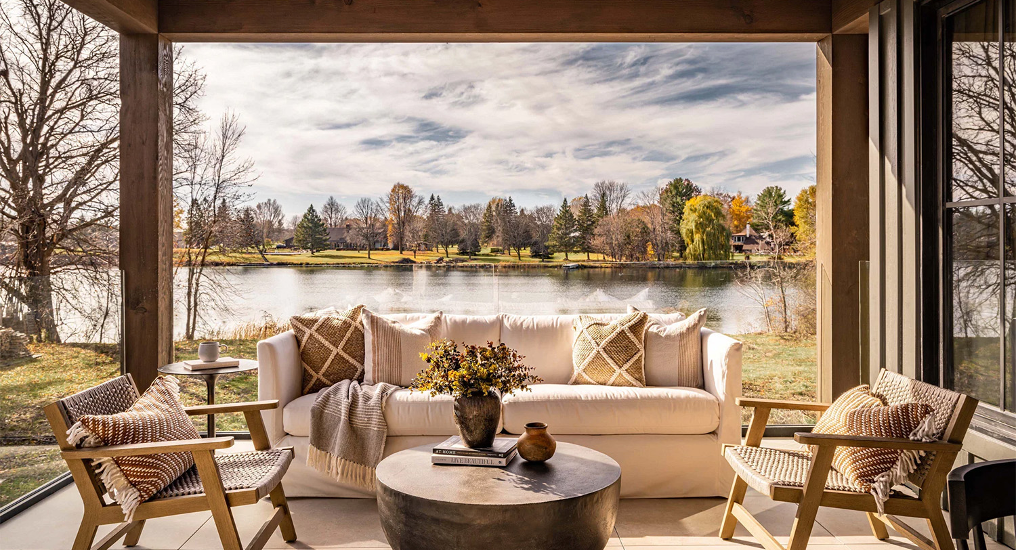
“We worked to create a variety of interior and exterior spaces that could suit different activities and times of day, says Russ. The waterfront open porch features a long view across the lake, and the owners love it for morning coffee. For less comfortable days, we created a three-season porch just a few steps from the kitchen and interior dining space. The overall forms, shapes, and even the colors of the building echo the historic local camps and cottages that dot the lake’s shorefront.”
Are you interested in finding or building your dream home on Lake Winnipesaukee or other lake regions in the country? Visit Lake Homes Realty to begin your search and enjoy the lake life!
Selecting a real estate agent often seems like an easy decision. You may choose a friend or just the first agent you come across. Other times, the number of real estate agents to choose from intimidates you. However, before deciding on an agent, consider your goals and what you want from selling your house. Motivated sellers want to sell their homes for the highest current market price in a reasonable time. Glenn Phillips, CEO of Lake Homes Realty, discusses the wrong and right questions to ask when choosing a real estate agent.
Wrong Questions
Which agents have the most listings? While there are great agents who have numerous listings, it isn’t always an indicator of success. Effective agents sell their homes and don’t let their listings sit on the market forever. Instead, ask about how many houses they sell.
Which agent do I personally like? You aren’t selling your house to make a new friend. Working with someone who you work well with is important; however, just because they’re your friend or family doesn’t automatically make them the best option. Don’t look to make selling your home personal. It’s a business transaction, and that’s how it should be treated.
Do they have an office nearby? Several lake home buyers come from out of town or even states away. When they come to town, they want to visit the house, not an office.
Better Questions
Are all agents the same? No, not all agents are the same, but it can be hard to tell the difference. Look for someone who is experienced; they should be able to explain the process and have a plan. Seasoned agents are successful at selling lake homes and can get you the best price.
Which agents are focused on lake real estate? When selling lake homes, exclude any agent not focused on lake real estate. Assume the buyer and their agent don’t understand the nuances of lake property. Having agents who don’t understand lake property leads to confusion and unexpected turns.
Which agents can prove they have a pipeline of out-of-town buyers? The right agent can produce a list of where their buyers are coming from. Putting your home on multiple different websites doesn’t always produce results. Good agents instead target buyers who are already interested in your lake.
Selling your lake home is a complicated process, so agents are there to help you. However, choosing the right one isn’t always the easiest job. Friends and family often make a strong case but aren’t always the best option. Visit lakehomes.com where agents who understand lake real estate can help you navigate the process.
Some companies like to guarantee you an offer for your home, such as an offer to buy your home if it doesn’t sell. Other companies offer to buy your home directly from you for fast cash-only transactions. Glenn Phillips, CEO of Lake Homes Realty, explains why Lake Homes Realty does not adopt these practices.
Guaranteed Offer is NOT the Same as Full-Price Offer: Guaranteed offers are generally lower than regular offers. They can be a good option if your only concern is selling your house quickly and you aren’t concerned with getting the full price. However, if you’re looking to get a good price for your house, guaranteed offers may not be for you.
Time: For typical residential property, transactions happen in a quick time frame. However, transactions for lake homes can take several years to finalize. Because of the sometimes unpredictable time frame for lake real estate, it’s difficult to determine a specified time frame for guaranteed offers.
Discretionary Buyers are Different: Lake home buyers are patient and can wait years before buying a house. With discretionary property, like lake homes, the buyers don’t have to buy the home. This nature of discretionary property doesn’t work well with the guaranteed offer strategy.
If your only concern is selling your lake home quickly, even if it means less money, then guaranteed offers can be the solution you need. However, the nature of lake real estate and lake home buyers is why Lake Homes Realty doesn’t adopt them. Visit lakehomes.com to find agents to help you navigate the lake real estate market.
If you’ve decided to sell your lake home, it’s important to understand what buyers do and don’t care about. Thinking like a buyer can help you sell your home quicker. Glenn Phillips, CEO of Lake Homes Realty, discusses five things buyers don’t care about, but many sellers think they do.
What Seller Paid: While the pricing history can be important, buyers don’t care what you paid for the house. Buyers are concerned with the current market, not about how much you need to get from your house.
Listed Price of Nearby Homes for Sale: The listing price of nearby houses doesn’t reflect their value. Many of those houses may be overpriced, especially if they’ve been on the market for a while. Buyers are more concerned with what the house is worth than the listing prices of nearby homes.
Seller’s Personal Effort: Patios, decks, and other features of the house can add value for some buyers. Oftentimes, sellers have emotional attachments to these features; however, buyers don’t always feel the same way. Buyers may want to remove those add-ons and see them only as an additional cost.
Outlier Sales at High Prices: Just because a nearby house sold for an irregularly high price doesn’t mean yours will too. Buyers understand the trend in prices of the pool of houses in the market, and most won’t pay that irregular price. Outliers generally aren’t repeatable, and buyers will buy at market price.
Taking Low Offers Personally: Buyers don’t make offers to offend you. Additionally, a low offer is still better than no offer. Not responding to low offers can cut off potentially interested buyers by leaving negotiation off the table.
As a seller or someone who’s thinking of selling your lake home, it’s important to think like the buyer. Considering what the buyer is looking for can help you sell your home quicker and maximize your potential profit. Visit lakehomes.com, where you can find agents who will help you navigate the home-selling process and who understand buyer’s wants and needs.