8 New Year’s Resolutions to Improve Your Home and Health

New Year’s resolutions typically begin with perfecting yourself, or at least bettering yourself by losing weight, quitting smoking, eating better, working more, etc., but we usually do not think about resolutions for our homes.

We always have a project we would like to work on, or have things around the house we should keep up on.

Here is a list of 8 New Year’s resolutions for better health and a happier home:

Quit smoking indoors

Or better yet, quit smoking altogether!

Smoking indoors creates a musky, over-powering odor, one non-smokers hard time being around.

Not only does smoking inside produce harsh smells, it creates a film over everything in the house like walls, windows and furniture.

If you have white walls and have been smoking for 2 years inside, they are probably more yellow-toned by now.

Watch your money

Keep your home finances to a budget; including household repairs.

Open a separate savings account designated for home repairs, changing or adding new items to the home, such as décor, new bedding, towels, etc., and household supplies such as a rake for the falling leaves, or salt for the drive way during the winter.

Conserve Energy

Learn how to be more energy efficient.

Use lights only when necessary, turn off all lights and TV’s when not in the room and use water when needed. Remember to check those leaky faucets!

Also. turn off the heat or AC, and open the windows when it is nice outside.

De-clutter and deep clean your home

This means going through each room and getting rid of what is not needed or wanted.

This may be a great way for you to make extra money by selling anything you think is worth something, either online or by having a yard sale. You could also donate your unneeded items to a local charity.

Make a resolution to keep your home cleaner. Most of us can sat this is one resolution we can afford to commit to.

Keeping a home clean helps our overall mood; it keeps us in a happy and productive mood.

A messy place where it seems everything is out of place can create a chaotic and stressful environment.

Focus on Family

Spend more time your loved ones.

Keeping your home full of family and friends is a great way to keep it fun and create memories at the same time.

Utilize your kitchen and make big family meals and invite all that you care about.

Start Small

Make small repairs, and other additions to your home, yourself.

By hiring someone, you are normally paying triple the amount it takes to do the project yourself.

If it is a simple repair or addition, such as adding a shelving unit, or painting the house, you can do that yourself and even invite family and/or friends over to help.

And if you don’t know where to start, we’ve got you covered.

Watch less TV

Limit your time in front of the TV by reading more or taking up a new hobby.

By making it a point to watch less TV, you are saving on the overall cost of electricity, but more importantly you are exercising you mind by reading or your body with outdoor activities.


The new can be the start of a new lifestyle. Give these tips a try for a happier, healthier 2018.


Karen Davis Named National Director of Brokerage Operations

Karen Davis, of Birmingham, Alabama, has joined Lake Homes Realty as the brokerage’s new National Director of Brokerage Operations.

Lake Homes Realty is the largest lake-focused real estate company in the United States, with licensed real estate brokerage operations in 16 states.

Karen Davis, National Director of Brokerage operations
National Director of Brokerage Operations Karen Davis

In her role, Davis will oversee both existing and new real estate brokerages in each state the company operates.

This will include assisting brokers and agents, managing the compliance team and refining brokerage back-office operations.

“I have been watching the growth of Lake Homes Realty since the beginning and was very impressed with what had been accomplished and the plans for the future,” Davis said.

“When they approached me about coming to work here, I saw it as an opportunity to be a part of something exciting that had really never been done before in real estate.”

Davis brings more than 20 years of experience in the real estate industry, having worked as both a licensed real estate agent and managing broker.

She is currently a licensed broker in Alabama and Georgia.

Prior to joining Lake Homes Realty, Davis worked for Signature Homes, a multi-state construction and real estate company headquartered in Birmingham, Alabama.

There she served in numerous roles managing home sales, property purchases and providing agent support.

Glenn S. Phillips, CEO of Lake Homes Realty, added, “Karen is a fantastic addition to our management team. We’ve known her for several years and have seen her be an incredible professional, as well as a genuine and caring person.

“As we grow the company, adding the right leadership to our team is imperative, and we are excited Karen has joined us.”

Through her work at Lake Homes Realty, Davis said she is excited to help the company continue its rapid growth while maintaining its high standards of integrity, service and compliance.

About Lake Homes Realty

Lake Homes Realty (www.LakeHomes.com) is a multi-state real estate company focused on lake homes and land.

Headquartered in Birmingham, Alabama, the firm is one of the fastest growing real estate companies in the country.

The company was named #927 on the 2017 Inc 5,000 and has been recently featured by Realtor® Magazine. Lake Homes Realty has also been named by the Birmingham Business Journal as one of the 30 fastest growing businesses in Birmingham each of the past three years.

Lake Homes Realty is a licensed real estate brokerage in 16 states, and is growing rapidly into additional states.

Choosing the Right Flooring for Your Lake House

Anyone buying or remodeling a lake home has a myriad of decisions to make. Many times, flooring is one of the last things you want to think about. Even so, lake home flooring is a very important decision!

If you are buying or remodeling a lake home, chances are you are already familiar with the effects of the elements. Lake homes withstand a huge amount of moisture, humidity and wear and tear.

Here are the most common flooring types and how they stack up against those elements.

Carpet

White farmhouse style bedroom with carpet lake house

Best for: Bedrooms, living rooms, upstairs hallways
Worst for: Kitchens, bathrooms, entryways

Many people think carpet is an automatic no-go for a lake house. Far from it! If your heart (and your soles) are set on having carpet in your home, never fear. Just keep a few things in mind.

The main worries for carpet on the lake are water, mud, and humidity. Those muddy footprints can add up pretty quickly!

But if your property isn’t waterfront, this might not be a serious problem. Many builders compromise by using hardwood or synthetic flooring in main entryways and kitchens, then carpet in the main living areas.

Carpet also gives comfy insulation during the winter months. Having a soft, comfy floor is a big plus on those chilly winter nights!

One hidden drawback of carpet is its absorbency. Carpet absorbs moisture, pet hair, dust, pollen, and mold. Many of these are in abundance at a lake house! If you are buying a previously owned lake house, be sure to clean the carpets when you move in.

Hardwood Flooring

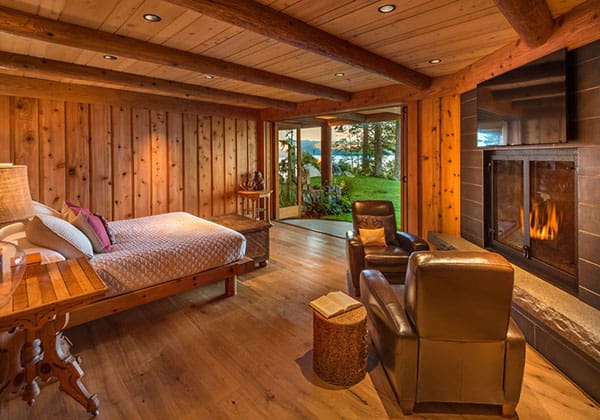
Hardwood flooring of lake house with fireplace and walk out patio
Photo courtesy of OneKindesign.

Best for: Living rooms, dining rooms, foyers, hallways, bedrooms
Worst for: Basements, bathrooms, kitchens, wet areas

Many lake homes have hardwood floors. There is a wide range of hardwood flooring options, from bamboo to pine, to oversea exotics such as mahogany and rosewood. These can be attractive, durable, and increase your home’s value.

The two primary concerns with hardwood on the lake are cost and the chance of water damage. Hardwood can be extremely expensive, depending on the wood chosen. Water damage from flooding, the elements, or just years of wet feet can be expensive to replace.

Hardwood is also vulnerable to humidity, especially in basements or other “below grade” areas. Many builders only use hardwood on or above the ground floor. Or you can use engineered wood. This uses a top layer of finished wood over multiple, thin layers of plywood or fiberboard. Amy Matthews, the host of HGTV’s Sweat Equity, says, “depending on the thickness of the veneer, engineered wood can be finished once or twice.”

Laminate / Vinyl Flooring

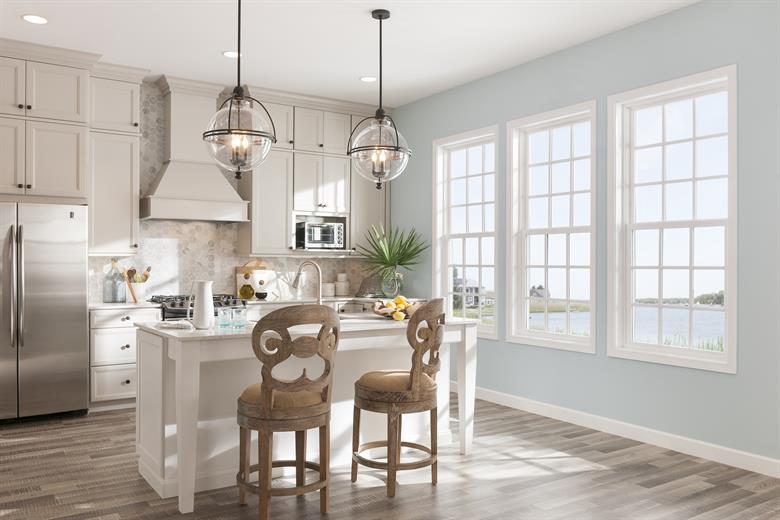
Vinyl laminate floors in lake house kitchen
Photo courtesy of Mi Windows.

Best for: Entryways, hallways, living rooms
Worst for: Bathrooms

Lake homes often sport vinyl or laminate flooring in parts. These are more affordable and durable than carpet or hardwood. Better yet, they have advanced greatly since the 1970s, when vinyl flooring, floral wallpaper, and lava lamps went hand-in-hand.

Laminate is a synthetic flooring with the appearance of hardwood. Vinyl is a synthetic flooring with far more options and can have the appearance of tile, wood, stone or other materials. Both come in panels of various sizes.

Many of these can beautify a home at a fraction of the cost used by hardwood or tile flooring. They can easily shrug off spilled drinks and muddy footprints, too.

Remember that these flooring options are not perfectly waterproof. They typically require a perfectly clean, level floor. Seams between the panels can let water in, as well, that could soak into the underlayment or subflooring. Be careful when using these in a bathroom, where small puddles of water are almost a daily occurrence.

Linoleum

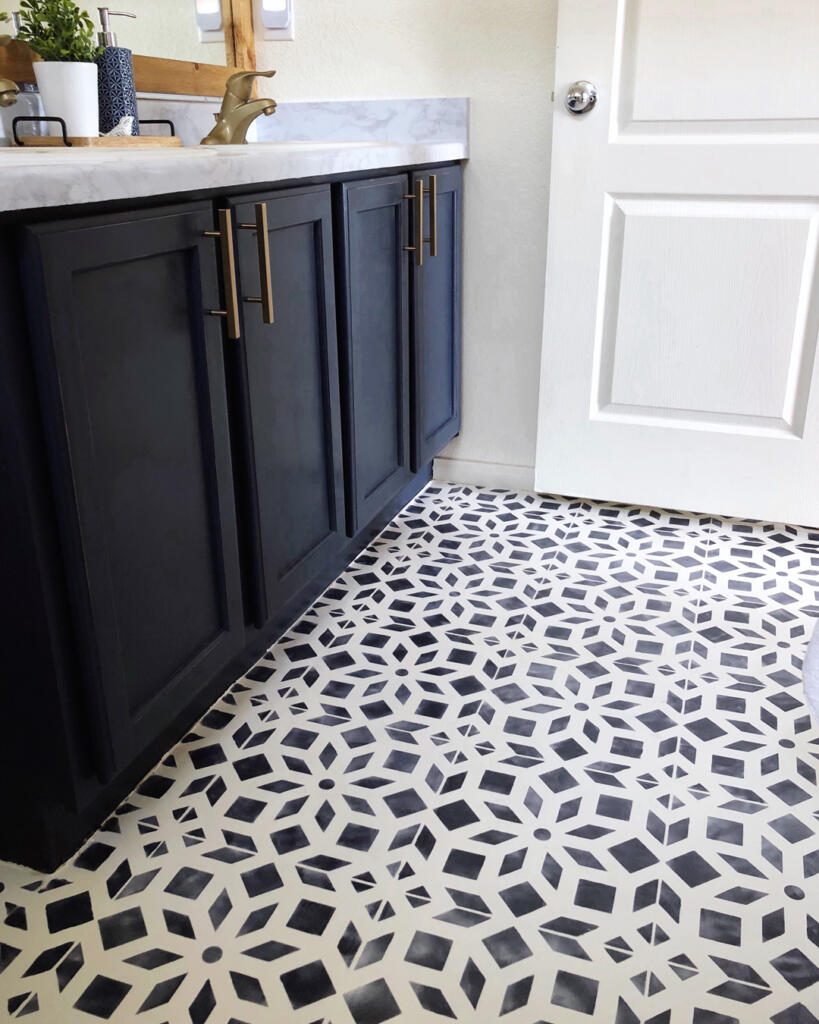
Hand painted linoleum floors with stencil navy blue
Photo courtesy of BBFrosch.

Best for: Entryways, kitchens, bathrooms­­­
Worst for: Sunrooms, bedrooms, rooms with rough concrete flooring

Another flooring that has seen a resurgence ­is linoleum. This synthetic flooring can come in either glue-down sheets, panels, or tiles.

The main difference between linoleum and laminate is the materials used. Linoleum is made from natural products, including linseed oil and sawdust.

Linoleum is more waterproof than laminate or vinyl tile. Because of this, it is more commonly used in areas like kitchens where spills happen frequently. When installing linoleum, be sure to waterproof the seams and edges.

Avoid installing linoleum flooring in any room with direct sunlight. The flooring will fade with time, and could even peel or warp. Install linoleum flooring in a sunroom, and you will most likely need to replace it in a few years’ time.

Ceramic or Stone Tile

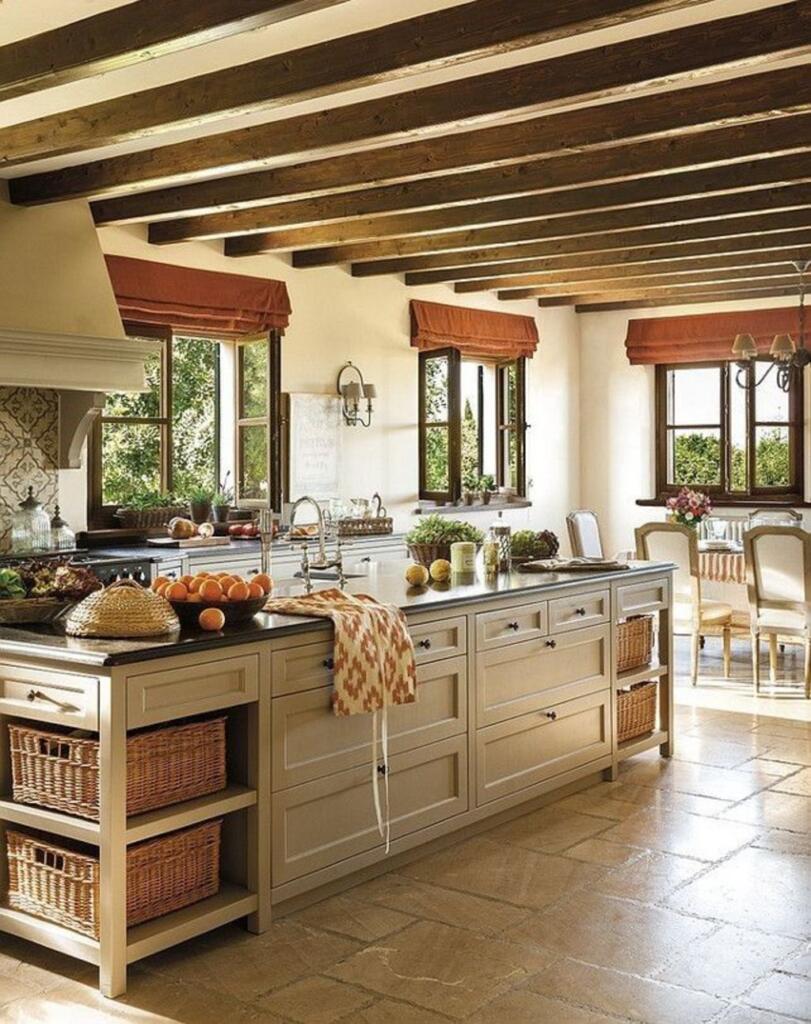
Rustic kitchen with stone tile
Photo courtesy of Elona Home.

Best for: Entryways, outdoors, kitchens, bathrooms
Worst for: Bedrooms

Many homeowners on the lake solve these water damage issues with ceramic or stone tile. Tile flooring is attractive, easy to clean and completely waterproof. It also comes in a wide range of textures and colors. A tile floor can give your home a warm, old-world charm; a crisp, clean surface; or any other look you desire.

Tile floors are more durable than nearly any other finished flooring. You can use it in entryways, kitchens, patios or anywhere you like.

The only true drawbacks to tile are cost, hardness, and temperature. Depending on the type, tile can easily cost more than hardwood. Tile can also be very unforgiving if you plan to stand for long periods of time, or if someone slips and falls. This is especially true for gloss finish tile.

Tile gets very cold in the winter, too. This is why builders rarely use tile in bedrooms or hallways.

Location, Location, Location

Couple selecting tile flooring at hardware store

Whatever your preference, a mix of flooring types will probably work best for your lake home.

Many builders use grading to determine what type of floor to use. “Grade” refers to ground level. Rooms at ground level are “on grade,” above ground level are “above grade” and below ground level is “below grade.”

Most builders never use hardwood, or other floorings susceptible to water damage, in below-grade rooms such as finished basements. Due to the proximity to the lake and the water level, this can bring persistent dampness or even water seepage. Any flooring susceptible to damage from moisture (such as hardwood) should not be used below grade.

For more home improvement and DIY tips, read more of our articles here.

Entrepreneur Magazine Shares Leadership Lesson From Lake Homes Realty CEO

Glenn S. Phillips, Lake Homes Realty CEO

Lake Homes Realty CEO Glenn S. Phillips was recently featured for his experiences in leadership on the business magazine website Entrepreneur.com

The article “5 Stories That Will Make You Rethink Your Leadership Style,”  by contributing writer Heather R. Huhman, shares the story of a significant struggle Phillips encountered while running his software company, Forté.

From this experience, Phillips learned the importance of embracing ongoing education.

Now, personal and staff education is a daily activity in his leadership role as CEO of Lake Homes Realty.

“I appreciate Entrepreneur magazine sharing my story,” said Phillips. “Everyone running a business can benefit from the lessons learned by peers and mentors. No one builds a business alone. I hope I’m doing a good job of paying-it-forward for all those who have helped me, and those who continue to help me.”

“In my case, this was a lesson learned the hard way, trying to just work harder,” he continued. “What was key, as I would learn, is that I needed more knowledge and different types of education behind that work.”

The article also includes helpful leadership lessons and “takeaways” from other business leaders around the country.

entrepreneur magazine logo Entrepreneur magazine is well respected in the business community. The magazine seeks to inspire, inform and celebrate entrepreneurs.

To read more of Phillips’ story, and those of others like him, visit https://www.entrepreneur.com/article/293842.

Getting Ready for your First Open House

If you are selling your home, chances are your real estate agent has spoken with you about an open house.

These are an excellent way to get prospective homebuyers in the door and get them talking to your selling agent.

If you are still living in your home, this can be tricky.

Here are some tips to help you work with your realtor and make your property as appealing as possible.

Clean, Clean, Clean

Now is the time to do all the spring cleaning you’ve been putting off, and then some. Vacuum, mop, clean the floors, wipe down the countertops and more.

Don’t neglect any out-of-the-way areas like the guest bedrooms, bathrooms or the garage, either. This is the time to clean the grout, tile, fixtures and appliances.

Remove the sources of any unpleasant odors. Even faint odors from a pantry, cigarette smoke or garbage disposal can often turn buyers off.

Especially if you have pets, vacuum the carpet, drapes and upholstery. Buyers with pet allergies won’t want to stay long otherwise!

If you don’t want to handle the cleaning all by yourself, consider hiring a cleaning service for a good, deep clean.

De-clutter

Buyers are attracted to properties where they can imagine themselves moving in as soon as possible.

Help this process along by removing any day-to-day clutter that might distract them from those happy thoughts.

Put away things such as laundry, dishes, bills, children’s homework or pet projects.

Make sure the dishwasher and sink are empty, and all trash cans are empty, even those in the bathrooms or garage.

When possible, you should also remove any prominent personal items. You want buyers to imagine your property as their new home.

Family photos, quirky fridge magnets, religious icons and sports memorabilia can make that difficult.

If removing framed photos leaves a big empty spot on the wall, you can temporarily replace them with a simple painting or other generic decoration.

Let the Sun Shine In

Homes look their best,  and their biggest, when they are open and well-lit.

Turn on every light in the house, other than those that cause noise, such as lights wired to kitchen exhaust fans.

Clean your windows and pull back the curtains, as well. If bushes or trees obscure the view, consider trimming them back.

Open windows always make a house look larger, especially in the living room.

Don’t let Rover come over

If you have pets, try to remove them during the open house, especially dogs.

Dogs can be very anxious or excited around visitors, especially if you aren’t there. No matter how friendly they are, your furry friends might give the wrong impression.

If you simply can’t remove your pets, for whatever reason, confine them to a specific part of the property, such as the garage.

Make sure they won’t bark or scratch at the door, and that your realtor is comfortable being alone with them.

Whatever you do, do not lock pets in sought-after areas such as the master bedroom. The entire point of your open house is to give buyers an in-person look at the property!

Protect your Belongings

Ideally, you will have several strangers looking and moving through your house. Make sure your belongings and valuables are kept safe.

Your realtor can’t be everywhere at once.

Remove or secure any jewelry, medication, electronic tablets and other valuables that might “walk off.”

If you aren’t sure where to put them, simply pack them in the trunk of your car until afterwards.

After the open house, double-check your doors and windows to make sure they are still locked.

Remember the Great Outdoors

Mow, trim, weed and wash!

Your front yard is the first thing visitors will see when they pull up. Make sure your lawn is already mowed, with the grass clippings blown or swept away.

Trim any bushes and remove any low hanging tree limbs that need removal.

If your house has vinyl siding or a brick exterior, this is the perfect time to give it a pressure wash.

This is doubly true for walkways, steps, and driveways. Removing a few years of grime and mildew can make your home stand out!

Don’t neglect the back yard, either. Visitors will certainly look there!

Put away any tools, children’s toys, lawn care equipment and other clutter. Outdoor furniture is a plus, but make sure yours is clean and doesn’t have any mildew or standing water in it.

If mosquitos are a problem in your neighborhood, light a few citronella candles in discreet places so they don’t harass your guests.

Leave!

This may go against your instincts, but most buyers are far more comfortable speaking with an agent, without the homeowner present.

Even if they don’t buy the house, they can often give your agent useful feedback that they might not give you directly.

Give your selling agent a complete rundown on anything they need to know, and let them work their magic.

If your home is a lake home, a selling agent who specializes in lake property can be a huge help with the lake-specific aspects of this process. Visit the Find a Lake Agent page on Lakehomes.com to find one in your area.

And be sure to check out our lake home specific open house article for additional advice and tips.

Deductions Aren’t the Only Way to Save on Real Estate Taxes

By Bill Brown, 2017 President of the NATIONAL ASSOCIATION OF REALTORS®.

Learn more about Bill on NerdWallet’s Ask an Advisor

The mortgage interest deduction and the state and local property tax deduction are probably the best-known tax incentives for homeownership and real estate investment.

That’s no surprise. Roughly nine out of 10 home buyers borrow money to buy a home, meaning they likely pay some form of mortgage interest. And property taxes are a near-universal expense for homeowners.

Both deductions are crucial to making homeownership possible for the average buyer.

But there are other real estate-related tax incentives that might not be as familiar.

Capital gains exclusion

All homeowners hope their property will appreciate.

The flip side is that anyone selling an asset that has gone up in value may get hit with a tax bill for the profit, also known as the capital gain. Thankfully, homeowners have some help in their corner.

An individual selling his or her principal home can qualify for an exclusion of up to $250,000 in capital gains, and married people who file jointly may qualify for an exclusion of up to $500,000.

There’s no need to report gains up to these limits on a tax return.

To take the exclusion, sellers must pass the IRS’ ownership and use test, but it’s fairly straightforward.

Essentially, they must own the property and have used it as a primary residence for a total of two out of the five years preceding the sale. Even if owners currently rent the property and depreciate it — as we’ll discuss shortly — they might still meet the use and ownership test and qualify for the exclusion. And even if sellers haven’t lived in the home during the past five years, they might qualify for a partial exclusion.

That’s a big help, as well as a recognition of the fact that millions of Americans depend on their home to build wealth throughout their lives.

1031 like-kind exchanges

The “1031 like-kind exchange” sounds like it’s ripped right from an accountancy textbook, but it’s actually fairly easy to understand.

Let’s say a person owns a single-family, detached rental home as part of an investment portfolio. If the home appreciates, the owner will likely owe capital gains taxes in the event of a sale — unless he or she uses the proceeds to buy a condominium in a market with higher rents.

Because the single-family home and the condo are both investment properties, tax law treats them as “like kind.” And because this transaction is a “like-kind exchange,” the owner won’t pay capital gains tax until he or she sells the new property.

This gives investors an incentive to put any realized gains back into the economy rather than pocketing them. And it’s a big deal: Major real estate investors and mom-and-pop investors alike can benefit.

Depreciation on rental property

Homeowners who rent a portion or all of their property might be able to “depreciate” that asset, which means deducting some of the cost of the property each year on their tax return.

That could result in a significant income tax deduction.

If you do earn money on the sale of your home after depreciation is taken into account, you’ll generally owe tax on the depreciated portion at the 25 percent “depreciation recapture” rate.

Any other gains will be taxed as capital gains.

Changes may be coming

For more than a century, the United States has recognized the benefits of homeownership and real estate investment.

It strengthens communities and helps individuals grow nest eggs for themselves. However, Congress is considering tax reform proposals that could have sweeping implications for real estate incentives.

That’s something to keep an eye on.

Everyone’s tax situation is unique. Before you count on any of these incentives, you may want to talk with a tax professional. But if you’re ready to take the plunge into homeownership or real estate investment, tax benefits — some obvious and others perhaps less so — are out there.

Bill Brown is the incoming president of the National Association of Realtors.

The article Deductions Aren’t the Only Way to Save on Real Estate Taxes originally appeared on NerdWallet.

NerdWallet is a Lake Homes Realty / LakeHomes.com content partner providing real estate news and commentary. Its content is produced independently of Lake Homes Realty and LakeHomes.com.

5 Steps to Take When You’re Ready to Sell Your House

Your home is likely your largest investment.

When it’s time to sell, you’ll want your investment to impress buyers and earn top dollar.

A real estate agent can suggest ways to make the process go smoothly, but all homeowners can take some basic steps even without professional help.

Here are five important steps to take when you’re ready to sell your house.

1. Declutter

Remove knickknacks, toys and other belongings that clutter the rooms in your house to make the spaces seem larger and more open.

Buyers will also have fewer distractions as they walk through the home.

Don’t plan on shoving your clutter into closets, though, because potential buyers will open closet doors as they tour your house. If you have a lot of clutter and find it hard to get organized, consider temporarily renting storage space for some of your belongings.

2. Repair damaged items

If you have small issues, such as holes in walls or lights that don’t work, now’s the time to fix them.

To get an idea of what you need to repair, walk through your home and imagine yourself as a buyer, or walk through with a friend you can trust.

Are there defects that you’ve learned to overlook but that would catch your attention when seeing them for the first time?

You’ll also want to make sure you correct major issues that a buyer may not see immediately, such as problems with the heating and cooling system, before you put your home on the market.

A potential buyer will probably hire a home inspector before closing. If the inspector finds problems, the sale could be put on hold until they’re resolved.

3. Deep clean

Go beyond your weekly cleaning routine.

Every surface a potential buyer sees is a surface that needs to be clean. Messy spaces could send the message that you don’t take care of your home, and it could make potential buyers wonder what else is wrong with the property.

A deep cleaning means shampooing carpets, washing windows and cleaning tile grout throughout the house.

Pay special attention to bathrooms; make sure fixtures are sparkling and wipe out any dirt rings or mold patches.

Keep up the cleaning routine while your home is on the market. If you’re pressed for time, consider hiring a weekly cleaning service.

4. Plan pleasing scents

You probably don’t want buyers who enter your home to catch lingering odors from last night’s dinner.

For a nicer aroma, add fragrances around the kitchen and throughout your home.

The smell of freshly baked cookies is pleasant for many buyers. If you prepare a batch just before a showing — and offer them to the buyer and real estate agent — you could make your home stand out.

There’s no need to worry if you’re not much of a baker.

A few well-placed sticks of cinnamon or citrus fruit, such as oranges, can also produce a refreshing scent.

In fact, a 2013 study published in the Journal of Retailing and reported by the Wall Street Journal determined that a simple orange aroma encouraged buyers to spend more money at a home decor store, compared with other scents.

5. Stage your home

Your decor expresses your personality, but home shoppers may have different tastes.

Consider changing the decor to appeal to a large number of buyers. This practice is known as “staging,” and it could mean you rearrange furniture, tone down dramatic wall paint with more neutral colors or even rent new pieces of furniture until the home is sold.

In a 2015 National Association of Realtors report on home staging, 52 percent of buyers agents reported that their buyers were willing to increase the amount of money offered for a staged home compared with a similar property.

You could ask your real estate agent for design suggestions and stage your home on your own. Or if you’d prefer a professional home stager, your agent may be able to suggest someone.

You can also contact the Real Estate Staging Association for names. The survey showed the median amount homeowners paid for staging services was $675.

Take note of these five steps to get your home ready to sell before you put it on the market. The effort you make repairing, cleaning and staging can pay off big when a buyer makes an attractive offer on your house.


Margarette Burnette is a staff writer at NerdWallet, a personal finance website. Email: mburnette@nerdwallet.com. Twitter: @margarette.

NerdWallet is a Lake Homes Realty / LakeHomes.com content partner providing real estate news and commentary. Its content is produced independently of Lake Homes Realty and LakeHomes.com.

Outdoor Renovations? Think Budget and Scope

Many homeowners view their outdoor spaces as their own personal oases, places where they can relax, dine and spend time with their friends and loved ones.

In light of this, it makes sense that homeowners consider investing in major features that will transform their outdoor areas into additional living spaces.

Like any home-renovation project, however, outdoor renovations can easily get out of control if you don’t have a good handle on how much things will cost, what your goals are and whether you’re doing the work yourself or need professional help.

Before you dive into an outdoor improvement, take these key considerations into account to help you stay on budget and ensure that your project is successful.

Match plan to budget

One of the key factors in the success of any outdoor project is determining a realistic budget long before you put shovel to topsoil.

Only once you’ve decided what you’re comfortable spending can you define the scope of your project.

The 2016 Houzz Landscaping & Garden Trends Study, conducted among registered users of the residential remodeling website, found that 88 percent of respondents had done or planned to do substantial renovations or complete overhauls, while only 12 percent had done or planned to do minor updates.

Knowing the scope of your plans in the beginning will help you get a basic sense of what the project will cost you.

In the Houzz study, nine out of 10 homeowners working on minor updates spent or planned to spend less than $5,000, but substantial updates called for bigger budgets — more than two in five homeowners working on a complete overhaul spent or planned to spend $20,000 or more.

Having a general understanding of the projects that are most popular among outdoor renovators can also be helpful as you develop your budget and scope.

Across all outdoor projects reported in the study, many homeowners were updating outdoor systems such as irrigation and lighting (82 percent), beds and borders (80 percent) and structural elements such as patios, terraces and gazebos (72 percent).

The costs of these projects vary significantly based on a number of factors, such as project nature, scope and professional involvement.

For example, while most standard outdoor systems such as irrigation or lighting in medium to small yards can be upgraded for less than $2,000, updates to beds and borders can range from a few hundred to thousands of dollars.

Renovation of outdoor structures is typically quite expensive and can easily start at a few thousand dollars and go up based on the type of structure and the extent of upgrades.

Pick your priorities

The next key factor to consider: What are you trying to accomplish with your renovation?

If outdoor living is top of your mind, you might concentrate on adding outdoor furniture, a fire pit or cooking features to enhance comfort.

If a low-maintenance space is a top priority, you might focus on adding plants that require little care and are resistant to cold, drought and wildlife.

When it comes to design, outdoor renovators most valued one that complements the style of their home (46 percent), promotes outdoor living (45 percent) and is stylish and beautiful (43 percent).

In terms of function, a space that’s easy to maintain ranked highest for homeowners (80 percent), followed by an area suitable for group gatherings and entertainment (49 percent).

Beyond creating an outdoor space that is aesthetically pleasing and easy to spend time in, many homeowners tackled specific challenges during their projects. Top issues included drainage troubles, lack of privacy and drought or water shortages.

Identifying your outdoor pet peeves or pressing concerns should make it easier to set project scope and budget. This will help you avoid project-scope creep.

Hiring a professional

More than half of outdoor upgraders in the Houzz study hired a landscape contractor or landscape architect/designer (52 percent) to help them bring their vision to life — and for good reason.

Landscaping professionals can open your eyes to a wide variety of options for your space that you might not be aware of, provide guidance for staying on schedule and budget, and tackle projects for which specialized skills are particularly beneficial.

Certain projects also require the hiring of licensed professionals to comply with local regulations.

Once you determine your budget, scope and top priorities, consider meeting with a professional for an initial consultation to discuss what you have in mind for your project.

Finding the right landscape contractor or landscape architect can make an entire project come alive. You may be surprised at how reasonable the professionals’ fees are compared with their contributions to the project and the quality of the final outcome.

An outdoor makeover can make an enormous difference in how you and your family enjoy your time at home.

In fact, after the completion of their outdoor project, 75 percent of homeowners reported resting and relaxing more often in their yards, 64 percent did more gardening and 55 percent entertained more frequently in their outdoor areas.

Keeping these tips in mind will help ensure that you not only complete your project without damaging your finances but also achieve an ideal outdoor space that you and your family will enjoy for years to come.

Nino Sitchinava is principal economist at Houzz, a residential remodeling and design platform and community.

This article originally appeared on NerdWallet

NerdWallet is a Lake Homes Realty / LakeHomes.com content partner providing real estate news and commentary. Its content is produced independently of Lake Homes Realty and LakeHomes.com.

Lake Homes Realty Crosses Mason-Dixon Line, Expands to Pennsylvania and Maryland

Lake Homes Realty is now licensed as a real estate brokerage in Maryland and Pennsylvania. This expands the company’s brokerage operations to 11 states.

The expansion into Pennsylvania marks the first company operations north of the Mason-Dixon Line.

The firm’s prior state brokerage operations have been located in the southeast and southwest regions of the U.S.

Preparation is also underway for company brokerage operations in other states across the northern regions of the U.S.

“Here we come!” said Lake Homes Realty CEO Glenn S. Phillips.

Growing for Service

“With each state we add to our service area, the better we serve our real estate buyers, sellers and our own agents,” added Phillips. “I’m very proud of the effort our team has made to continue our company growth. We are hard at work to add brokerage operations in even more states in 2017, so this will be a very exciting year for us.”

Jason Hightower is the Lake Homes Realty broker for Maryland and Rachelle McClard for Pennsylvania.

Philips said the company was already visiting with top real estate agents in both states.

“We are looking for agents who will understand the power of the LakeHomes.com platform and are focused on concierge levels of personal customer service. The power of the web plus the power of people is critical in this business.”

The company also shared that growth in existing markets is continuing across the southeast and southwest U.S.

Who is Lake Homes Realty?

Lake Homes Realty is one of the nation’s fastest growing real estate companies and is a full-service, lake-focused real estate brokerage.

The company’s unique operations model is built around the concept of a one-stop website for lake homes and land, while coupling this with the brokerage’s own licensed local market expert real estate agents.

The company has foregone a focus on brick-and-mortar locations. Instead the company invests in a select group of top producing local agents and in providing consolidated lake real estate listings for consumers via the company website, www.LakeHomes.com.