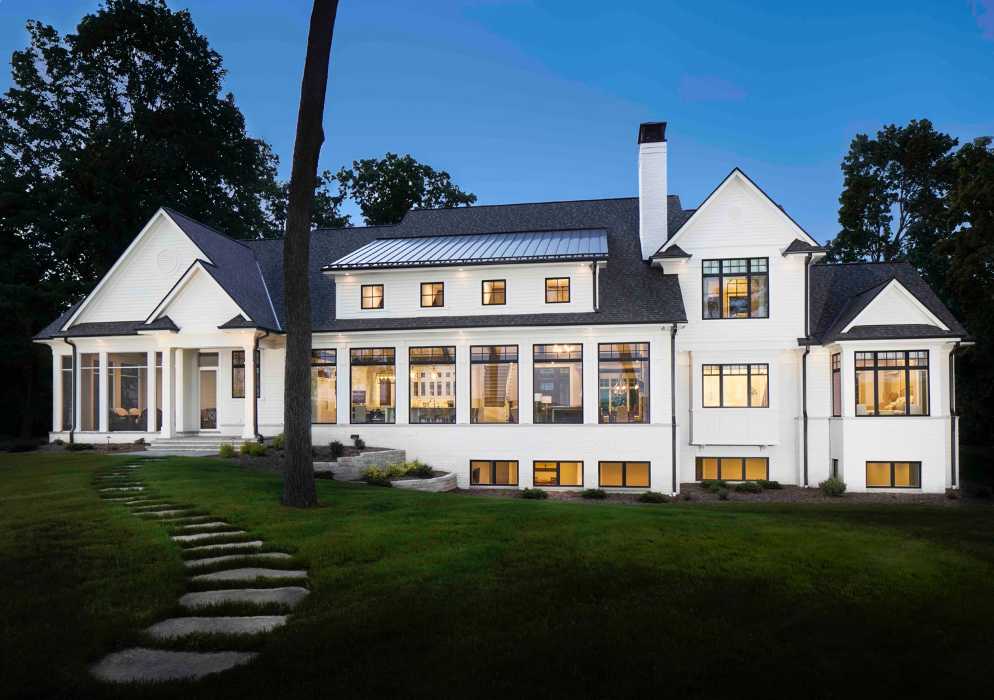
Selling a lake house is an exciting but difficult undertaking, and your main goal as a homeowner is to secure the greatest offer possible. However, it is critical to exercise caution because the highest offer may not always be the most lucrative. Let’s look at some important points to consider when selling your lake house to prevent financial hazards.
1. Avoiding Selling Too Quickly: Resist the urge to accept early offers; instead, wait for perfect market circumstances to obtain the best price.
2. All Cash Transactions: Be wary of all-cash proposals since they may come with lesser bids and make it difficult to negotiate a fair bargain.
3. Limited (or no) Contingencies: Carefully evaluate proposals with fewer conditions to prevent any legal or financial problems.
4. Seasoned Real Estate Agents Who Understand Niche: Work with seasoned agents who specialize in lakefront properties for professional advice, effective marketing, and skilled negotiating.
A thoughtful and informed approach to selling a lake house may make it a rewarding experience. While a large offer may appear appealing, it is critical to consider all elements to prevent financial disasters. Take your time, investigate all-cash bids, evaluate conditions, and seek advice from experienced lakefront real estate brokers. With these safeguards, you may sell your cherished lake house with confidence and optimize your investment return.
If your lake home is currently on the market, or it will be soon, it’s important to know key things about buyers. As a seller, you may have certain home transaction qualifications that are important to you whereas these same priorities may not be important to a homebuyer. Lake Homes Realty’s CEO, Glenn Phillips, has some insight into the top 5 things sellers may care about, but buyers don’t.
What the seller paid: Phrases such as “This is what we paid” usually don’t coincide with what the buyer thinks. They’re looking for the best price. The market will set the price that will sell.
Listed price of nearby homes: What’s listed for and what sells are two different things. You should instead be aware of what the homes are selling for. The buyers are already aware of this.
Personal effort on customizations: The emotional value put into house might mean a lot to you, but for the buyer the same sentimental feeling isn’t there. You personal style isn’t the same as everyone else’s.
Rumors of outlier high prices: Just because your neighbors sold their home as a high outlier doesn’t mean the circumstances will occur for you. You may have priced higher based off a rumor.
Taking low offers personally: No offers are worse than a low offer. Try countering the offer and negotiate during the transaction.
At the end of the day, buyers are ready to jump on some great options. You just have to make sure you go about it in the right way. If you’re ever looking for more help, contact an agent at lakehomes.com. They know how to get buyers and are more than willing to help!
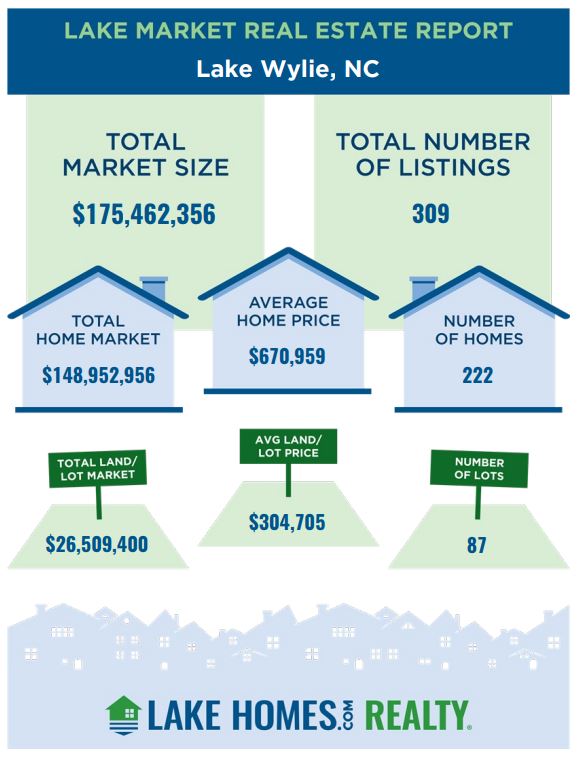
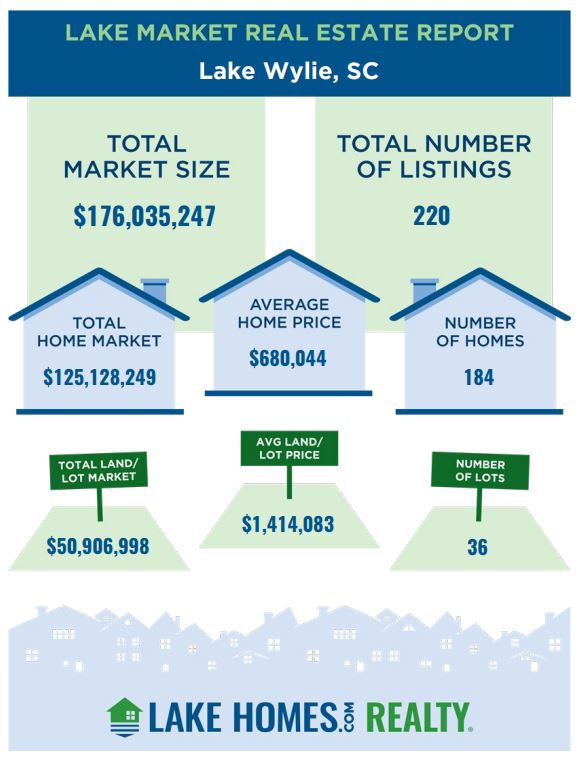
A new lake real estate report from the country’s largest lake-focused brokerage show listing prices in North Carolina and South Carolina are up over summer 2022. “The new Lake Real Estate Market Report from Lake Homes Realty shows South Carolina’s total market at $1.4 billion, up from $1.3 billion in the summer of 2022,” said Katie Pendleton and Matt Nielsen, new agents with Lake Homes Realty, who focus on Lake Wylie in North and South Carolina. Lake Homes Realty operates in 34 states across the country.
“The new quarterly lake real estate report from Lakehomes.com shows Lake Wylie to be the second largest market in the state of North Carolina and the largest market in South Carolina,” said Pendleton. “The specialized website just showcases properties that are lakefront, have a lake view or lake access so we can help clients from across the country search for dream lake properties.” As of June 14, 2023, Lake Wylie across both North and South Carolina has a combined 529 lake area properties listed, ranging from a $39,000 lot in South Carolina to a $5.9 million lake home in North Carolina. “Fifty-three of the properties were listed for over $1 million,” said Nielsen.
The average home price for listings around Lake Wylie is between $670,959 and $680,044, depending on which state you’re looking at, according to the Lake Market Real Estate Report. The average lot price in North Carolina is $304,705 for the 87 lake area lots currently listed. The average lot price in South Carolina is $1.4 million for the 36 lake area lots currently listed, featuring a $39.5 million lot covering 395 acres.
“Boating is extremely popular on Lake Wylie, as are its related activities, waterskiing, tubing, and wakeboarding,” said Pendleton. “With almost 13,500 acres of pristine water, it ventures into both North and South Carolina. Lake Wylie appeals to lake home searchers from across the country. Among the hundreds of people searching the lake homes and lots on Lake Wylie in May 2023, the top Metro area looking on LakeHomes.com was Atlanta, Georgia, followed by Washington D.C., and New York City,” said Nielsen. “ The national reach offered by LakeHomes.com works really well with my local expertise along Lake Martin and the surrounding area,” said Nielsen. One in 37 American adults look at LakeHomes.com each year.
“We believe our agents’ intimate knowledge about their lake real estate markets, nuances of the lakes themselves, and their involvement in local lake life is paramount to our continued growth,” said Glenn S. Phillips, CEO, and Chief Economic Analyst for Lake Homes “Katie and Matt offer outstanding customer service in the Lake Wylie areas and are truly specialists in that area,” he said.
About Katie Pendleton and Matt Nielson
Matt and Katie, a dynamic couple who specialize in selling properties in the picturesque Lake Wylie area. With deep-rooted connections to the region, both Matt and Katie have cherished memories of growing up near Lake Wylie. Although originally from New York, Matt’s love for the lake life was sparked by his grandparents who resided there.
Katie’s connection with Lake Wylie dates back to 1983 when her uncle purchased a lot on its shores. She spent her formative years fishing, boating, and tubing on the very lake she now helps others explore. Drawing from their extensive personal experiences, Matt and Katie have become true authorities on all things related to Lake Wylie. Not only do they conduct business in the area, but they also reside there, actively participating in the local community.
Both Matt and Katie are driven by a simple yet powerful goal: to make their clients feel like VIPs. They go above and beyond to ensure that every transaction is seamless and stress-free. As residents of Lake Wylie, they understand firsthand the incredible joy and fulfillment that comes from embracing the lake lifestyle. Guided by this passion, they derive immense satisfaction from assisting others in realizing their dreams of living by the lake.
In addition to their thriving real estate business, Matt and Katie are loving parents to three energetic sons who constantly keep them on their toes. Family is of utmost importance to them, and they are deeply committed to serving their community, particularly through various nonprofit organizations. As passionate lake enthusiasts, they also collaborate with environmental groups, working diligently to preserve the pristine beauty of Lake Wylie for generations to come.
As you’re getting ready to put your lake house on the market, the topic of selling price will always come up. More than likely you will think “Can I get more money for my lake home?” Lake Homes Realty’s CEO, Glenn Phillips, explains a few different ways to help push for that price you want to sell for.
Start with a Market Appropriate Price: Buyers don’t care how much money you have put into the home. Most of the time they will be looking at the current market conditions. When you start at a high price to test the market, it usually does not result in the way you would like.
Be clearly the best VALUE in the area: Don’t automatically make your lake home the lowest price. However, check out surrounding homes and see what’s going on. Are there nicer or newer homes nearby? Are these homes your price or lower? New construction may also become a player in this.
Picture Perfect/Move-In Ready: Whether you already have your home staged or simply have your own property in the house, make sure it appears move-in ready. Buyers typically lack imagining this aspect and this will help you stand out.
Would you buy it today at your price? Each day the house doesn’t sell and remains on the market, you are effectively buying it again at your price. In reality, the only price is that of what someone will pay and what you’re willing to accept. Price accordingly and price from a buyer mindset.
At the end of the day, these 4 tips are useful in getting the best return and sell price for your lake home. , Connect with one of our lake agents today at lakehomes.com and see what they can do!
Lake Homes Realty recently added Kimberly Hewitt to their real estate team in Oklahoma. Along with Donna Barnes, Hewitt will be serving the Grand Lake area which, according to the recent Lake Market Real Estate Report, has a total of 276 lake property listings, ranging from a $3,500 lot to a $4.5 million lake home. The average home listing in the area is $609,383 and the average lot price is $262,170.
About Kimberly Hewitt
Having spent her entire life near Oklahoma’s lakes, Kimberly Hewitt has developed a deep connection with these natural wonders. Born and raised in Fairland, Oklahoma, a mere thirty-minute drive from Grand Lake, she now owns a beautiful lakefront property in the area. Throughout her adult life, Kimberly has always managed to reside near bodies of water, with Lake Keystone being her home for many years.
Kimberly has nurtured a lifelong aspiration of becoming a real estate agent. Her past experiences revolved around new construction and home remodeling, fostering her strong affinity for the industry. Over time, her initial enthusiasm has transformed into a genuine passion. This passion led her to achieve remarkable success as a real estate agent, earning an award during her first year for selling an impressive $4.3 million worth of properties.
“I love to help clients find their dream homes,” Kimberly says. “It’s great to see them step into a home and know it’s a place where they can make memories with family. Making them happy makes me happy!”
It was a grandmother’s dream to create a family lake getaway for her daughter, son-in-law, grandchildren, and everyone’s friends. Their previous retreat on Wisconsin’s Green Lake was proving to be too long of a weekend drive—four hours from the young family’s home in Chicago. So, the grandparents decided to search for a closer place to build their forever lake home. As luck would have it, they found a lot on Lake Nagawicka, the most desired lake in Delafield, Wisconsin, just two hours from Chicago. Fast forward to the completion of their idyllic waterfront home—a blissful place where the family gathers nearly every weekend, and the grandmother lives all summer long.
But long before this house became a reality, the grandmother—and her entire family—worked meticulously with interior designer Kelly Guinaugh, owner of the award-winning full-service studio Interior Enhancement Group, to build her dream lake home piece by piece.
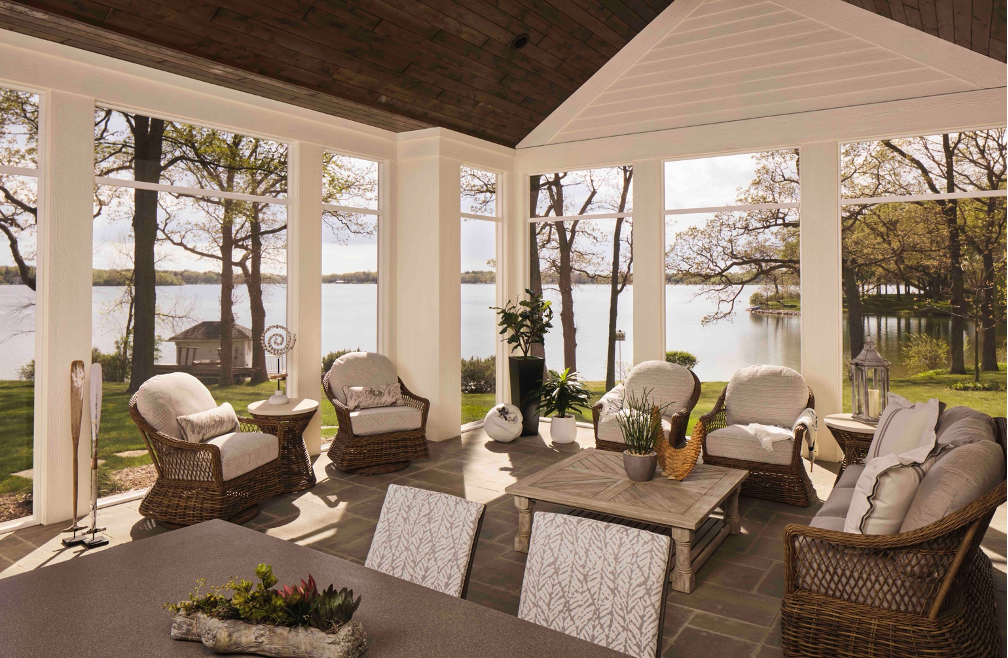
“This lake home was created to be a warm, inviting place for three generations to gather year-round and make memories,” says Kelly. “So, the windows are large and placed to maximize the beauty of the lake and the beach where the grandchildren play in the summer.” Case in point: This beautiful three-season screened-in porch offers alfresco time in the evenings—without mosquitoes—and can be enjoyed from early spring until the late fall.
Four-Season Splendor
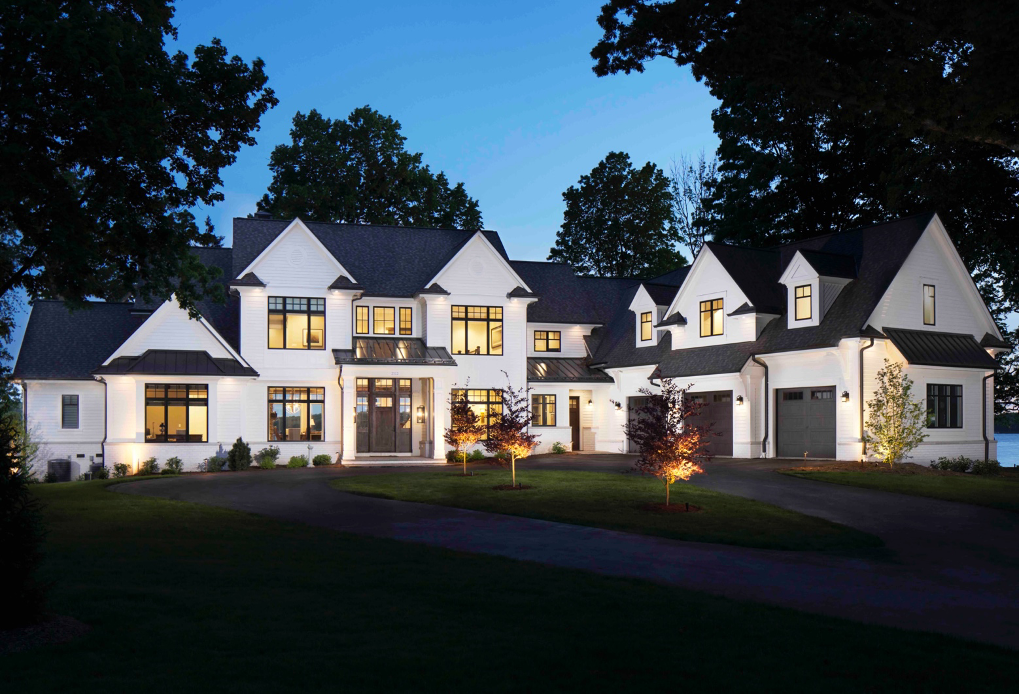
To honor the property’s scenic setting, it was important to build a home that blends into the landscape and does not detract from the nature surrounding it. The white brick-and-board exterior radiates a clean aesthetic and a stately presence that is impactful yet understated, given its sprawling dimensions of more than 8,000 square feet. In addition, the dwelling features soft traditional elements juxtaposed with modern details, such as dark window frames that create a bold and dynamic contrast.
“One thing that stands out is how open Kelly and her team were to all of us wanting to be involved in making selections and creating the feel of the space,” remembers the daughter. “Also, this was a meaningful project for our family—it was my dad’s dream home, but he passed away unexpectedly before construction began. So, we were emotionally invested in realizing his vision.”
Soaring Heights
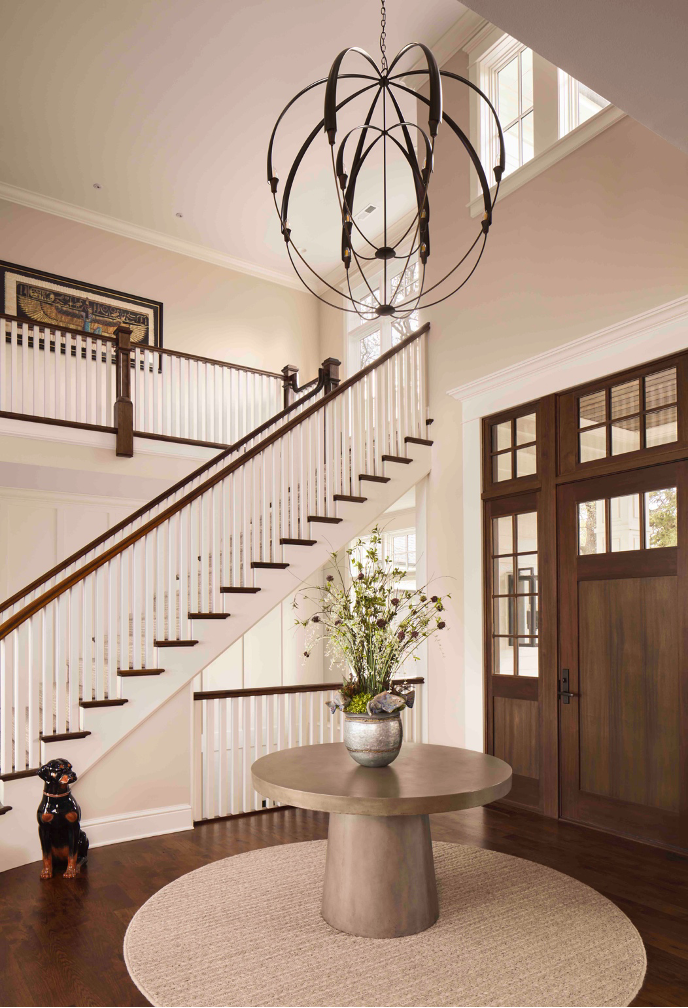
The home’s uncluttered appeal begins in the sunlight-drenched foyer, where a sweeping staircase amplifies the grand scale of the two-story ceiling height. An elegant wrought-iron chandelier, chosen for its massive size and graceful lines, befits the proportions of the space. A round and nubby wool rug echoes the circular shape of the concrete pedestal table. Plus, a single keepsake vase and a whimsical dog figurine make decorative accents spare yet substantial enough to complement a large space.
“Interior millwork details were important,” says Kelly. “We worked alongside the architect to create a batten-board wall design that blends with the two-story ceilings and the lower ceilings in other areas. We used gorgeous five-inch-wide hickory floors with character marks that feel great under your feet in all seasons—even in the Midwest.”
Center Stage
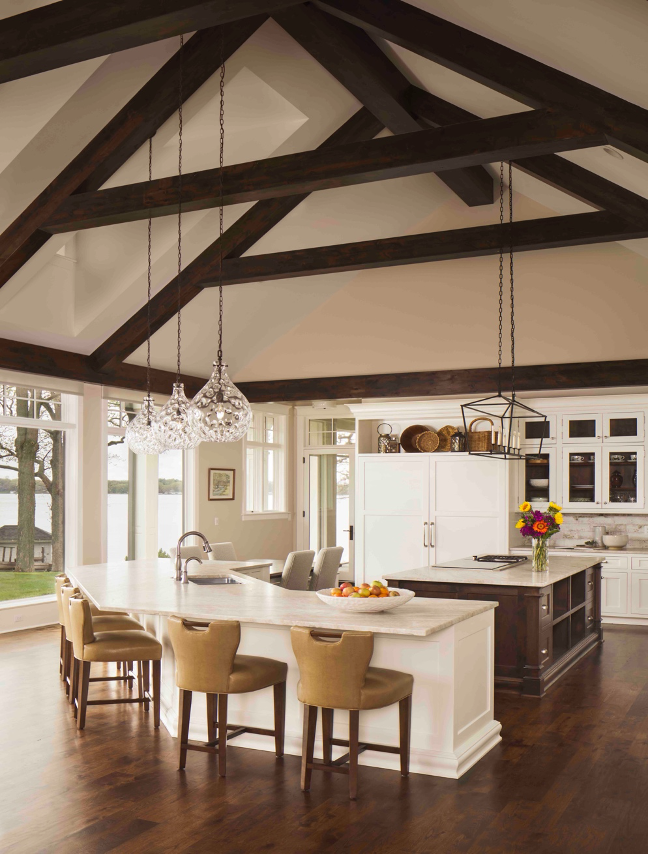
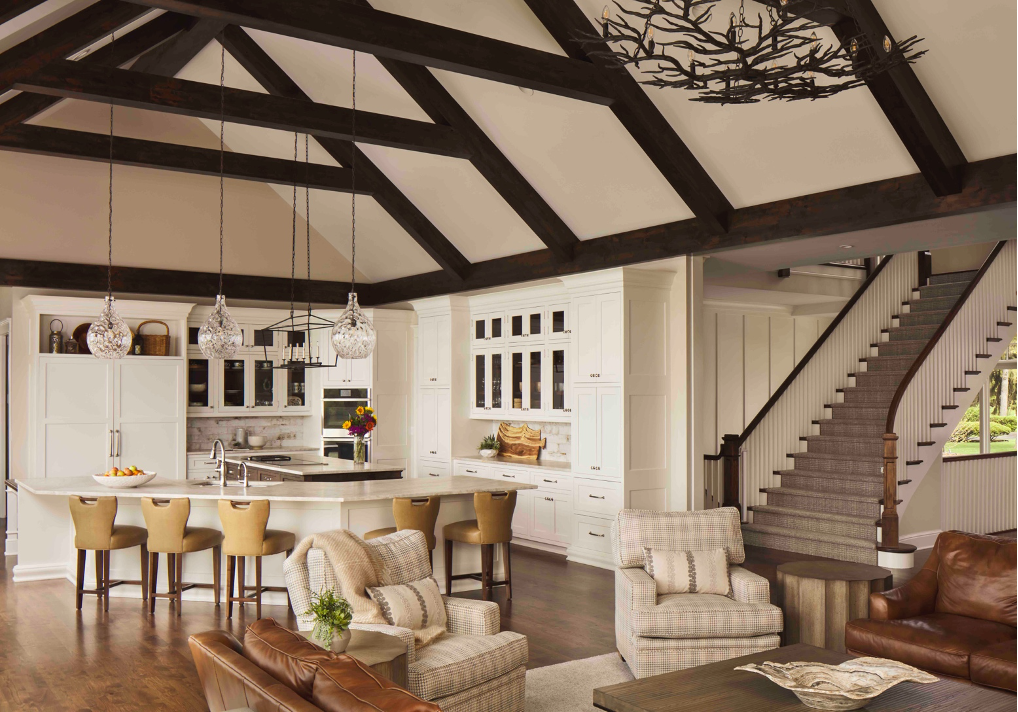
On top of the grandmother’s wish list was a big, open kitchen where she could cook to her heart’s content and still be part of the action. Hence, the open and airy design provides plenty of countertop/prep space, seating for guests, and, of course, glorious views of the lake from every angle. “The kitchen backsplash tile is rustic in design but highly polished,” notes Kelly, “This seemed counterintuitive at first but ended up being the perfect complement to the stone countertops.”
An Easy Flow
Because the grandchildren are a big part of the family dynamic, the design team kept areas open and free of furnishings so they could play between the kitchen island and the great room. “We always adhere to the space plan, so we know what works in terms of traffic flow and furniture dimensions,” Kelly explains. “The architect had planned the home so all rooms would have the best views, and we wanted to ensure the interior selections played to this as well. So, we didn’t select any especially tall pieces because we wanted to keep the windows unencumbered, and we used minimal window treatments for the same reason.”
In addition, the lake home’s color scheme was carefully considered regarding what hues would blend best with the natural environment. A soft palette of coastal blues and greens mixes with caramels and browns for an earthy touch of warmth. “We kept to quiet patterns as well,” notes Kelly, and again, our focus was always on the amazing property this home was built upon. Plus, we also were very aware that a home is only inviting when you feel like you can really live in it.”
So, with that sentiment in mind, and without sacrificing her design selections, Kelly used stain-resistant, durable fabrics almost everywhere to take the worry out of family fun. “Now everyone says it is their favorite escape,” she adds, “a place where they feel welcome and pampered. Mission accomplished!”
Great Room Grandeur
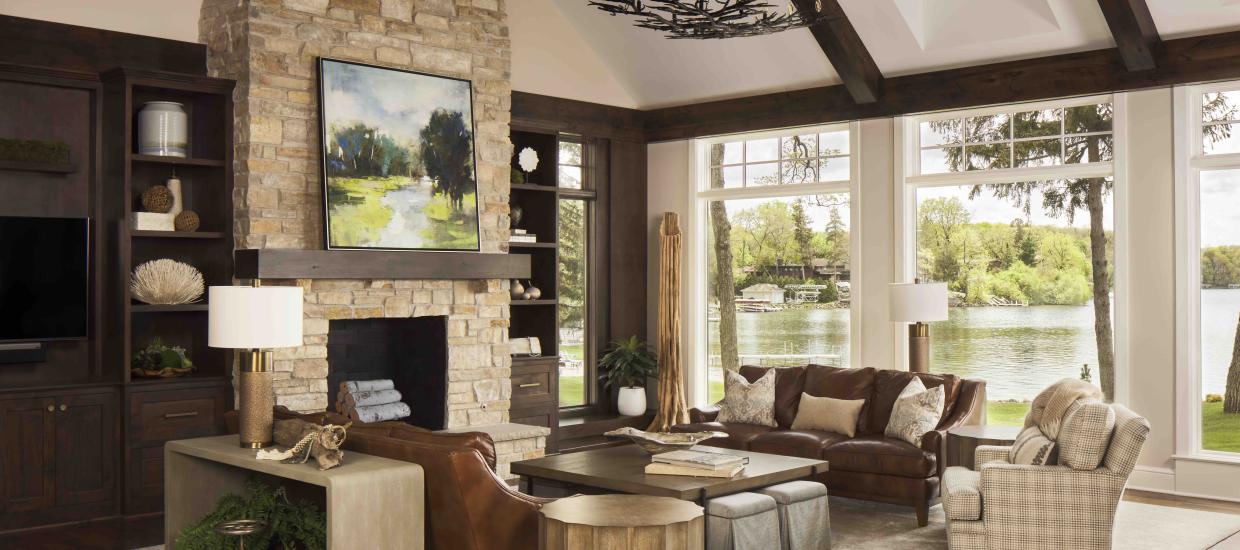
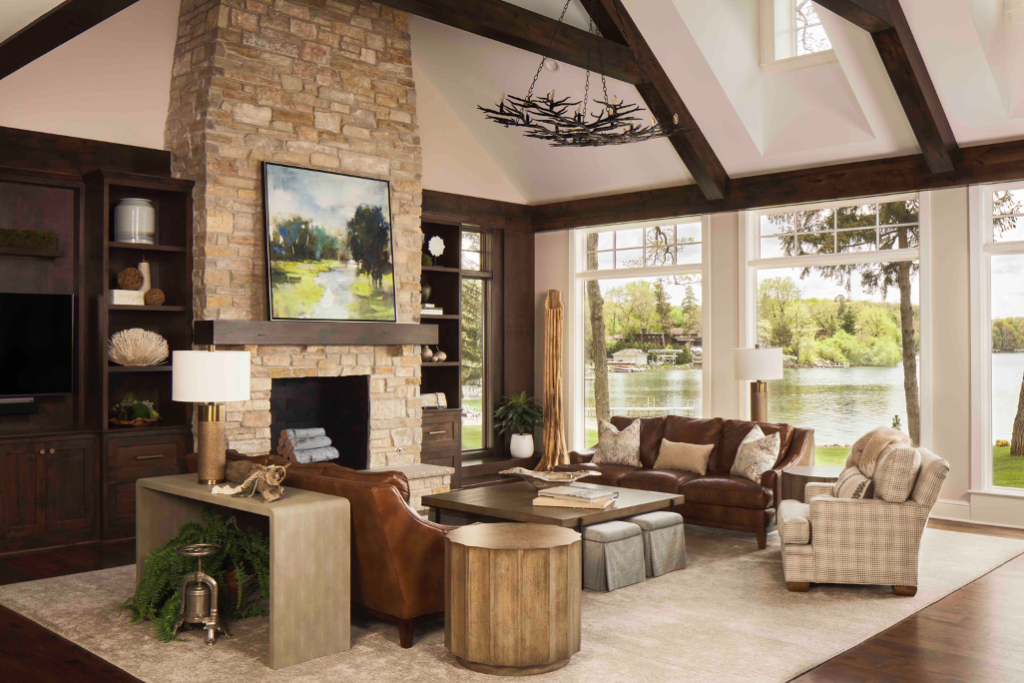
In the great room, Kelly and her team introduced texture with a magnificent Wisconsin stone fireplace and richly patinaed wood floors anchored with a plush wool area rug. In addition, the ceiling beams and flooring have character markings to bring a well-worn aged feeling to the home, and a smooth level-five drywall finish creates a striking contrast to the wood’s warm walnut stain. She then layered in textural accents, such as the tall tree trunk flanking the window, a branch-like chandelier, and a mix of soft upholstery fabrics, supple leathers, and sumptuous throws and pillows. “Because of the room’s enormous size, we needed a large cocktail table,” Kelly adds. “Also, to make it even more useful, we tucked small ottomans underneath for the grandchildren to sit on while coloring and playing.”
Throughout the home, Kelly incorporated essential furnishings from the owners’ previous lake home and heirloom pieces that had special meaning. Here, a duck collection on the built-in shelves and an old grape press placed under the console table continue her theme of mixing the old with the new.
Warm Family Gatherings
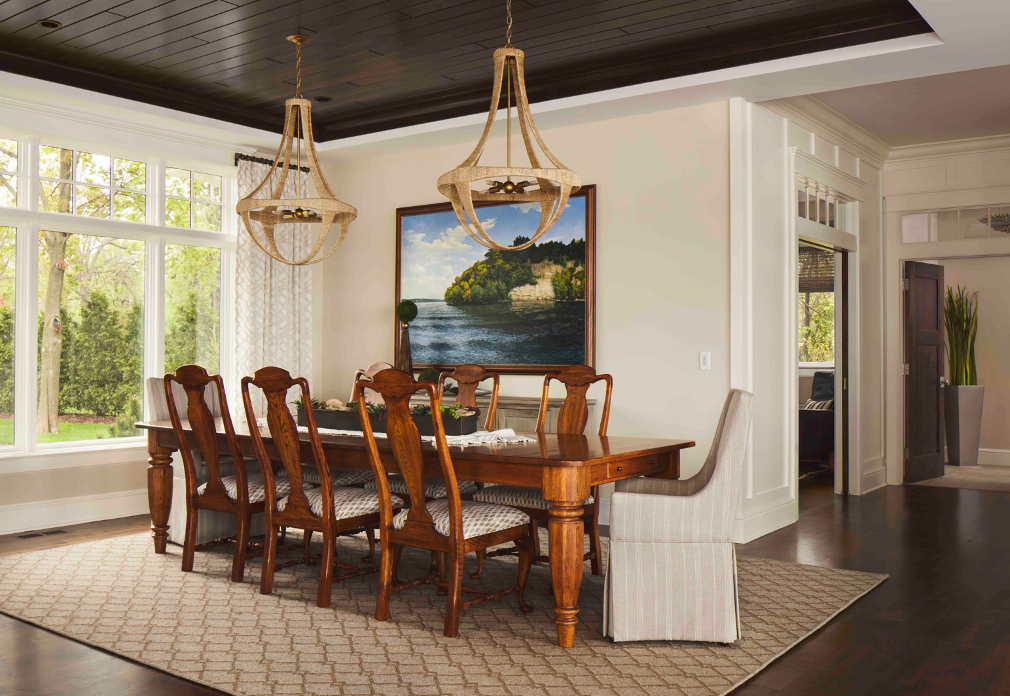
The dining room’s relaxing effect is largely due to its walnut-stained recessed ceiling treatment that gives the space a warm and inviting feel. In addition, a colorful landscape painting emulates the home’s color palette and the waterside environment. Overhead, a pair of rattan chandeliers lend texture to this traditional dining space.
Quiet Time
Bathed in soothing shades of brown, this home office makes a cozy spot for reading or playing chess on rainy afternoons. A vintage-style rug grounds the space with bold patterns and colors while complementing neutral-hued upholstered seating and an ornately carved antique desk—an heirloom from a great grandfather. In addition, meaningful pieces of nautical-themed artwork from the owner’s collection mirror their scenic lakeside setting.
Naturally Neutral
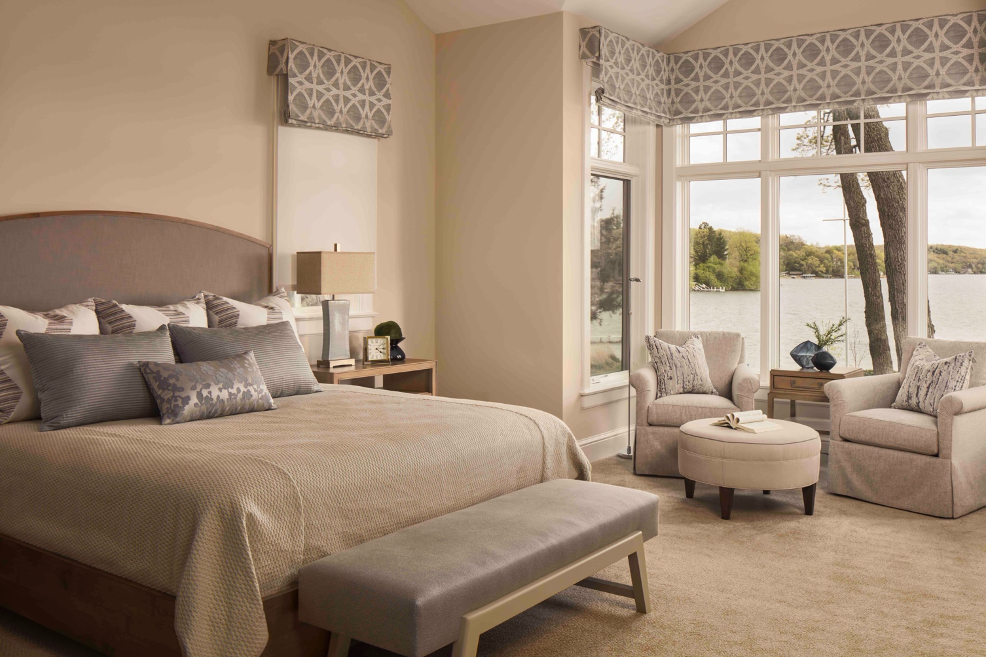
In the primary bedroom, beautiful beiges, creams, and blues blend with the landscape, making an almost seamless indoor/outdoor transition. Plus, the soft palette makes a restful oasis from which the owner can enjoy the splendid lake views.
Spa Retreat
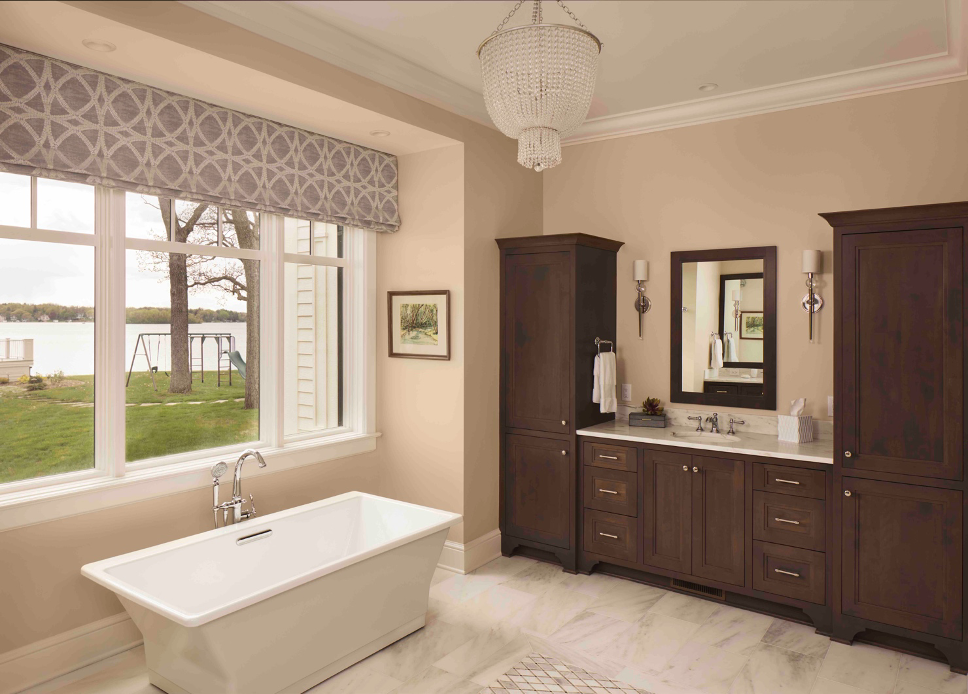
Even the primary bathroom connects with the outdoors via a wide expanse of windows that backdrop a luxurious soaking tub. In addition, dark-stained cabinetry provides a rich contrast to the white marble flooring and vanity surface, and a beaded crystal chandelier creates a refined spa-like ambiance.
Memories in the Making
With endless lake activities and nearby hiking trails, the idyllic property offers plenty to do outside in all seasons. Plus, Lake Nagawicka is as beautiful in summer as in winter, when snow gathers on the tree branches and the lake landscape is blanketed in white. Delivering spectacular shoreline appeal, this meaningful getaway has proven to offer more than enough space for the entire family and extended family members to gather for Thanksgiving, Christmas, and all holidays and weekends in between.
“In the end, Kelly and her team’s job could have been a lot easier with clients who just gave them free rein,” says the daughter. “Instead, they got me, my mom, and my husband—with all our emotional investment in the project, our varying design ideas and needs, and a lot of sentimental family treasures to incorporate into the space. Amazingly, they were able to weave all of that into a design that gives us a family home filled with meaning and memories. We couldn’t be happier with the result.”
A foreclosed home on the lake is a rare find. Lake Homes Realty’s CEO, Glenn Phillips shares why your search for one is coming up short.
LakeHomes.com, MLSs, & Other Websites: While homes like these are available on sites like LakeHomes.com, you may have trouble finding them because of how few there are.
Why So Few?
Not the 2008 Market: While inventory spiked during the recession, this was not the case for lake properties. This is because lake homeowners are more financially sound than the average buyer.
Interest Rates Affecting Sellers: Lake homeowners that have a mortgage don’t want to battle with increasing interest rates when buying a new home.
Lenders are Well Positioned: Due to past real estate crises, lenders have policies in place to ensure they work with stable buyers.
Majority Do Not Have a Mortgage: More lake home buyers paying in cash means fewer mortgages and fewer foreclosures.
If you still have your heart set on a foreclosed home, LakeHomes.com will have the few left available!
Purchasing a lake home is not something to take likely. Before you commit to a property, consider these factors from Lake Homes Realty’s CEO, Glenn Phillips.
Bridges?: The location of bridges will impact how convenient it will be to travel around the area. However, the closer you are to one, the closer you’ll be to traffic.
Water Levels?: The water level can vary by lake, season, and time of day. It’s important to know the behavior of your preferred lake, as the changing levels can affect lake activities.
Shoreline Restrictions?: Research the restrictions surrounding the shoreline, as they tend to fluctuate throughout the area.
Land Restriction?: Most lakes are owned by an organization, which means you’ll run into leased-land properties. You’ll have to follow their guidelines when buying these types of homes.
Water Restrictions?: Living by the lake doesn’t guarantee you have free range on the water within it. Check out the rules around water activities, water addition/removal, etc.
When buying a lake home, the property itself isn’t the only thing to consider. Be sure you can live the lake lifestyle you want before you buy!
April 11, 2023 – Hoover, Ala. – With lake home and lot inventory rising over last spring and preparing to heat up this summer, Lake Homes Realty prepares for long-term growth. The country’s largest lake-focused real estate brokerage doubled its square footage by moving into a new headquarters in late March, along with RealSource Title Insurance and Real Estate Closings. Based in Metro Birmingham, Lake Homes Realty currently operates brokerages in 34 states and remains in a rapid growth mode. The hiring of two seasoned real estate executives is a key part of the company’s growth plan.
Joe Gaeta has joined Lake Homes Realty as the Director of Strategic Growth and Kiki Wanshura has been hired as Director of Market Acceleration. Gaeta has more than 24 years of real estate industry experience, including the past seven years with Zillow Group as Director of Broker Relations. Wanshura has been in the industry since 1997 and came to Lake Homes Realty from Pacaso where she was on the Industry Relations team for the past two years. Her experience with second home ownership pairs nicely with current and potential agents interested in joining Lake Homes Realty. Gaeta and Wanshura will be working closely with Heather Glass, another former Zillow Group executive. Glass was recently named to the newly created position National Director of Development at Lake Homes Realty.
Real Estate Industry Experts Join Lake Homes Realty
Heather Glass, Joe Gaeta, and Kiki Wanshura of Lake Homes Realty
“With Joe and Kiki joining Heather along with the move to our new corporate headquarters, exciting times are ahead for Lake Homes Realty,” said Glenn S. Phillips, CEO and Lead Economic Analyst of Lake Homes Realty. “The appeal of a primary or secondary lake home on our thousands of lakes remains high and inventory is on the upswing as summer approaches,” said Phillips. “Our lake home buyers and sellers are, for the most part, unaffected by mortgage rates and economic uncertainly,” he said.
“We remain highly focused on the lake real estate market and believe Joe, Kiki, and Heather have the experience to identify key agents in lake real estate and similar niches as we continue to expand,” said Doris Phillips, COO at Lake Homes Realty and President of RealSource. “The three of them have powerful real estate backgrounds and the personalities to make a significant impact in expanding our market footprint.”
Gaeta, Director of Strategic Growth, joined Lake Homes Realty in April and has a passion for the industry. “It was so important for me to lock arms with like-minded people,” said Gaeta. “Over the last seven years, I have had the pleasure of visiting with Glenn and Doris Phillips from time to time – and working with them has always been a joy,” he said. “I love the specialization of their mission and how they are truly changing the lives of their agents. Many brokerages promise huge success, Lake Homes Realty actually delivers on it,” he said. Having worked with both the broker and agent community, Gaeta believes his experience will help move the needle for Lake Homes Realty and the future projects ahead. “Agents sometimes get stuck and my goal is to help them get unstuck,” he added.
Coming from Pacaso, Wanshura understands the second home industry and believes Lake Homes Realty is positioned well for the future. “ Having worked at a variety of real estate companies, I continue to be incredibly impressed with the tools, technology, and valuable analytics that Lake Homes Realty offers that are unique to the industry,” said Wanshura, who joined the company in March. “ I want to continue my career with a company like Lakes Homes Realty – a progressive company that is making a positive impact in the real estate industry,” she said. Shortly after obtaining her real estate license, Wanshura started teaching classes at her local association of REALTORS. “I quickly realized that I love helping agents grow their own business,” she said. “I think my passion for the industry along with my passion to help agents be more successful will be a great asset to Lake Homes Realty.”
After working with Zillow Group and Moxiworks, Heather Glass joined Lake Homes Realty in 2020 and was recently named National Director of Development. “The leadership and the entire Lake Homes Realty family is set up to make our agents successful,” said Glass. “Joe, Kiki, and I will show lake real estate agents how to differentiate themselves from the competition. Our agents double their revenue within their first years gaining value with the best in the business,” she said. “We often say that even experienced agents joining us get to learn from the A-Team of lake real estate agents.”
New Headquarters
“We toured a wide variety of office space available in Jefferson and Shelby Counties and felt 500 Corporate Parkway best met our needs,” said Phillips. “Over the past 12 months our space has transformed dramatically and is a great environment for our employees, clients, and guests,” he said. “ As Lake Homes Realty and RealSource continue to grow, we will have space to accommodate our workforce. We are also excited to be part of Hoover’s expanding technology corridor along Highway 280,” he added. As a hybrid of technology and traditional real estate brokerages, technology is at the forefront of Lake Homes Realty and it will be beneficial to be surrounded by other tech companies.
SDM Partners of Atlanta owns the 500 Building and surrounding buildings. The new headquarters were designed by Williams Blackstock Architects of Birmingham and the building is managed by Colliers International. Lake Homes Realty and RealSource moved into the 500 building in mid-March. A ribbon cutting with the Hoover Area Chamber of Commerce is planned for April 18.
“I am very pleased Lake Homes Realty and RealSource will remain and grow in Hoover,” said Mayor Frank Brocato. “This project is another example of growth in Hoover’s STEM-based industries. I also am pleased that this public/private partnership will assist Hoover entrepreneurs to further grow and contribute to the city’s economy.”
Glenn S. and Doris Phillips – CEO and COO of Lake Homes Realty